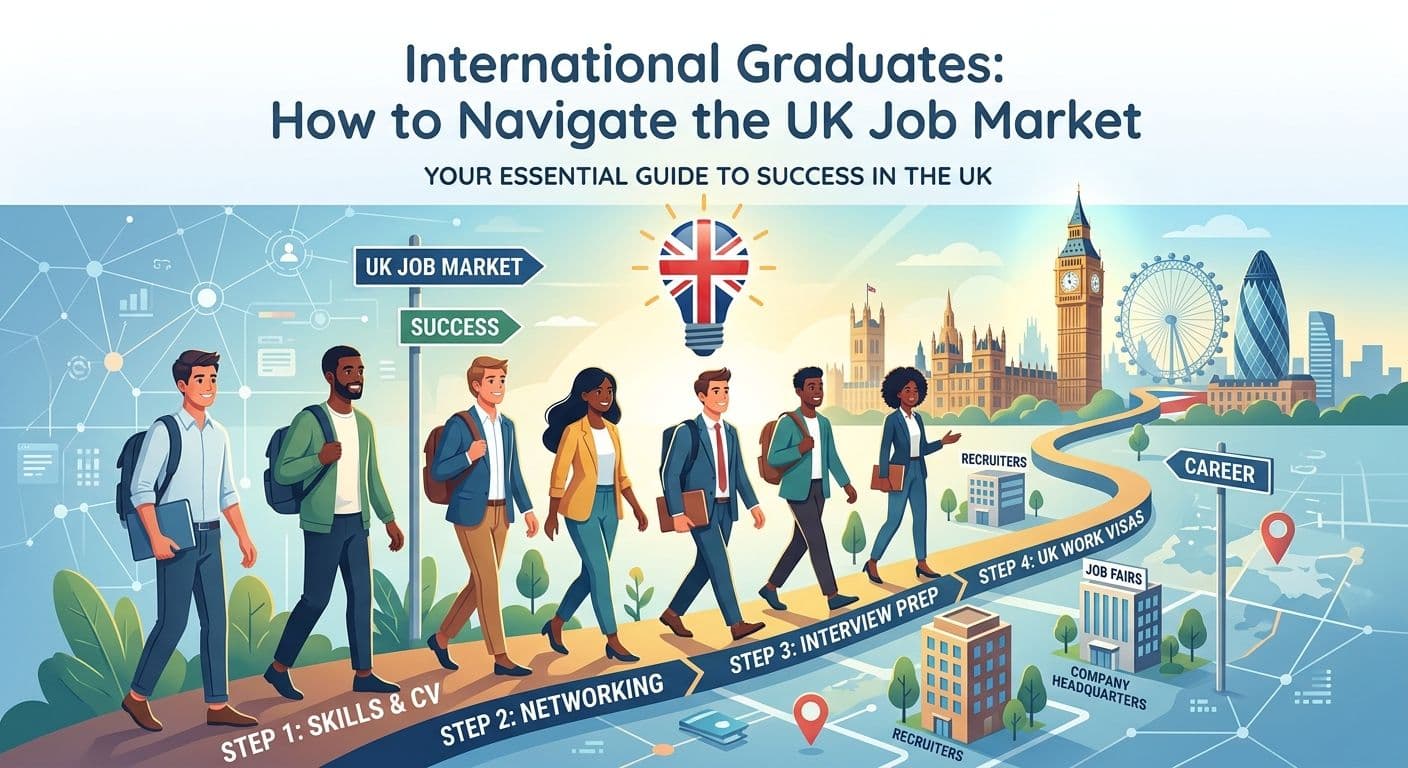
Finishing a degree in the UK opens real doors. The job market here is deep, internationally recognised, and accessible to people who understand how it works.
The problem is that understanding how it works is not obvious. The application process has conventions that are rarely written down. Visa requirements add a layer of complexity that most job search guides ignore. And most of the advice online is written for domestic candidates.
This guide is written for international graduates specifically. It covers your visa options, how UK applications actually work, and how to position your experience to compete on equal terms.
Visa options: start here
Before anything else, you need clarity on your right to work. Applying without understanding your visa situation wastes everyone's time.
The Graduate Route
If you completed a degree at a UK higher education institution, you are likely eligible for the Graduate Route. This lets you stay in the UK for two years after graduation (three years for doctoral graduates) to work or look for work, at any skill level, without requiring employer sponsorship.
This is a significant advantage. You can apply to any employer, including those without a Skilled Worker sponsor licence, and start work immediately. You do not need a sponsored role during this window.
Use this time carefully. UK work experience strengthens any future Skilled Worker visa application considerably.
The Skilled Worker visa
If you need to extend beyond your Graduate Route window, or if that window has already closed, you need an employer to sponsor you under the Skilled Worker route. Not all employers hold a Home Office sponsor licence.
Before investing significant time in an application, check whether the employer is on the Home Office register of licensed sponsors at gov.uk. Applying to an unlicensed employer for a role that requires sponsorship leads nowhere.
When applying to sponsoring employers, address your visa situation clearly and early, in your cover letter if the role mentions sponsorship, or at the first interview. Trying to delay this conversation creates problems and damages trust.
How UK applications actually work
The cover letter is a substantive document
In many countries the cover letter is a formality, a brief note restating the CV. In the UK, particularly for graduate and professional roles, it carries real weight. It is your opportunity to show that you understand the role, the organisation, and why your specific experience makes you the right candidate.
A UK cover letter is no more than one page. It opens with why you want this specific role at this specific organisation, not a general statement about your career. It draws on one or two strong achievements framed around what the employer needs. It closes with a clear statement of intent.
Competency-based applications
Many UK employers, particularly large graduate schemes, public sector organisations, and financial services firms, use application forms that ask you to answer specific behavioural questions. These are not optional extras. They are the primary basis for shortlisting decisions.
Answer every competency question using the STAR method. Be specific, write in first person, and always include a measurable result. Generic answers that could apply to any candidate are the most common reason competency applications fail at shortlisting.
Sector knowledge matters
Employers in competitive sectors such as finance, consulting, law, and technology expect candidates to know the field they are entering. This means understanding the current landscape, being aware of relevant challenges, and being able to say specifically why you want to work in that sector.
This knowledge cannot be faked at interview. Build it through reading industry publications, following relevant organisations on LinkedIn, and talking to people already working in your target sector.
Networking is not optional
A substantial share of UK roles are filled through networks rather than job boards. Commonly cited estimates put this at 60 to 80 percent. This is not a reason to ignore job boards, but it is a reason to invest in professional relationships.
LinkedIn is the main professional networking platform in the UK. Keep your profile current and accurate. Connect with alumni from your university who work in your target sector. A shared institution is a legitimate basis for reaching out.
When contacting professionals, be specific and brief. "I am a recent graduate interested in X and would welcome 20 minutes to hear about your experience" is a reasonable ask. A connection request with no message is not.
International experience is an asset, not a gap
One challenge international graduates face is the impression, sometimes stated, sometimes not, that pre-UK experience is less relevant. This is a framing problem.
Cross-cultural competence, multilingual ability, experience in different regulatory environments, and knowledge of emerging markets are all things domestic candidates often cannot offer. The question is whether your applications are making this clear.
Do not present international experience as background. Present it as evidence. "Having managed supplier relationships across three countries with different regulatory frameworks" is a stronger statement than "having worked abroad before coming to the UK."
International experience is not a gap. It is evidence, if your application frames it correctly.
Practical steps to take now
- Check your Graduate Route eligibility and calculate your timeline exactly
- Search the Home Office sponsor register for your target employers before applying
- Update your LinkedIn profile and start connecting with alumni in your target sector
- Build three to five STAR stories from your experience, including international roles
- Research two or three target organisations in depth so you can speak specifically about why you want to work there
When to get support
Navigating the UK job market as an international graduate is genuinely more complex than it is for domestic candidates. You are managing visa considerations, adapting to unfamiliar application conventions, and doing this while building a professional network from scratch.
The question is whether managing every part of your own job search is the best use of your time, or whether having expert support on the research, applications, and submissions would free you to focus on what you can control: preparation, networking, and interviews.
Navigating the UK job market is hard. We can help.
CareerKit reads any UK job description, matches it to your international experience, and generates a tailored ATS-ready application in minutes. Join the waitlist free. climblly.com/careerkit
Climblly Managed takes the full process off your plate. We research roles, build the applications, and submit on your behalf. Book a free discovery call. climblly.com/managed