Ask most professionals to describe a work achievement and they will tell you what they did. They will walk through the project, describe their responsibilities, explain the process. What they rarely do is say what happened because of it.
This is the most common failure in job applications and interviews. The experience is real. The work was genuine. But the story is incomplete, and incomplete stories do not land you roles.
The STAR method exists to fix this. Used properly, it turns a vague description of responsibilities into a precise narrative that shows exactly what kind of professional you are.
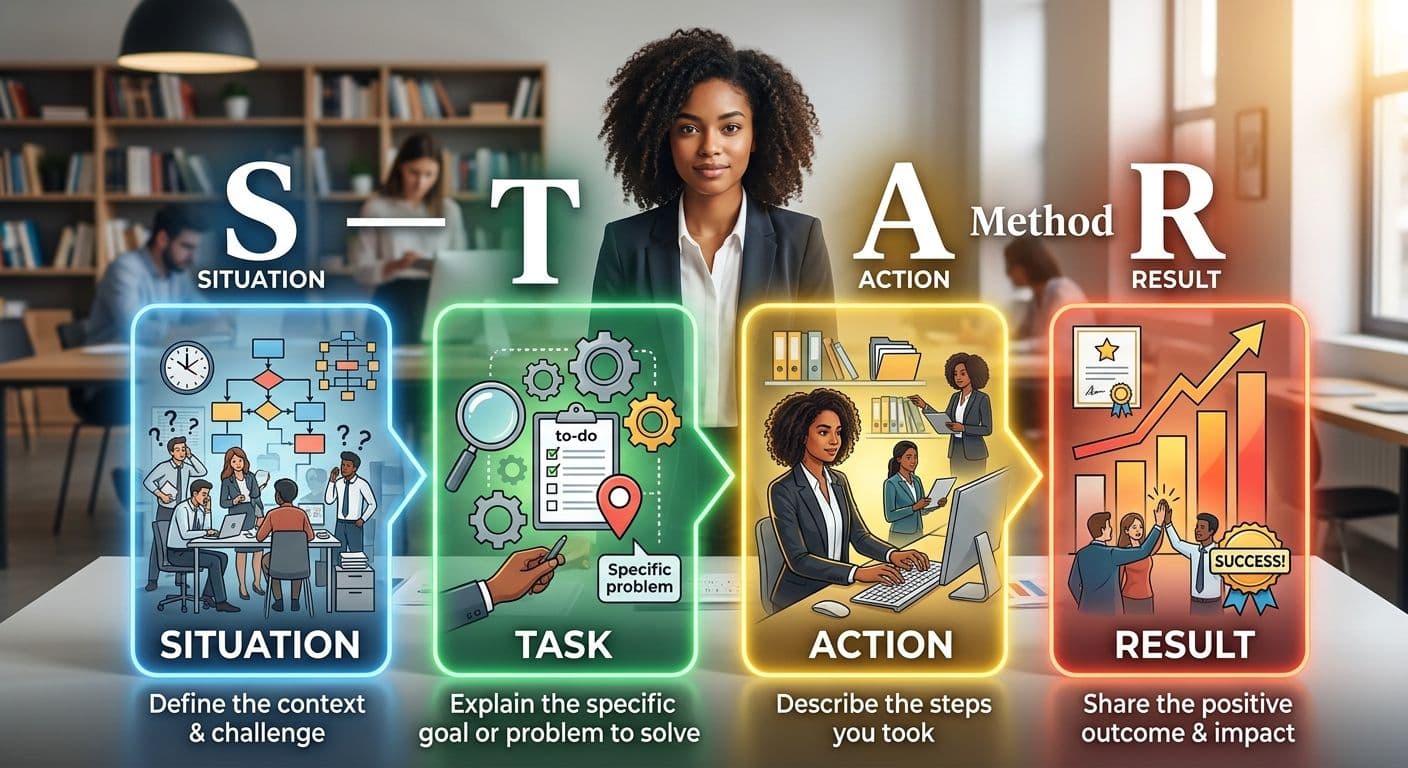
What each element actually means
Situation
The Situation sets context. What was going on before you got involved? Keep it to one or two sentences. Enough to understand why what follows matters.
The common mistake is spending too long here. Context is a frame, not the picture. Keep it brief.
Example: "Our team had missed monthly targets for three consecutive quarters, and client satisfaction had fallen by 18 percent."
Task
The Task describes your specific role. What were you asked to do? What problem were you accountable for?
The common mistake is confusing Task with Action. The Task is what you were responsible for. The Action is what you actually did. These are different things.
Example: "As the newly appointed team lead, I was responsible for diagnosing the underperformance and presenting a recovery plan to senior leadership within 30 days."
Action
The Action is the heart of the story. This is where you show how you think and what you actually did. It should be specific, first-person, and focused on what you decided and executed, not what the team did or what happened.
"We implemented a new system" is weaker than "I proposed and led the implementation of a new tracking system, training a team of six within two weeks."
Do not summarise. Walk through the specific steps, decisions, and approaches you took. This is the evidence.
Result
The Result is what most candidates skip or generalise. This is the proof. What changed? What was the measurable outcome?
If you can attach a number, do it. Quantified results are more credible and more memorable than qualitative ones.
"The project was a success" tells a hiring manager nothing. "Client satisfaction recovered to 94 percent within two quarters, and we exceeded monthly targets for the remaining six months of the year" tells them everything.
"The project was a success" tells a hiring manager nothing. Numbers tell them everything.
Finding your metrics when your work has no obvious numbers
The most common objection: "My work doesn't have clear metrics." This is rarely true. It usually means the metrics are not the obvious kind.
Consider:
- Time saved: "reduced the reporting process from four hours to 45 minutes"
- Volume: "managed a caseload of 80 clients simultaneously"
- Scale: "the training programme I designed was rolled out to 200 staff across three offices"
- Before and after: "the team's error rate dropped from 12 percent to under 2 percent"
- Recognition: "the project was cited in the company's annual report as a flagship initiative"
The exercise of finding your metrics is valuable in itself. It forces you to think clearly about the real impact of your work, often for the first time.
Applying STAR in written applications
You do not use the acronym explicitly in a CV or cover letter. You write each bullet point so it implicitly follows the structure: context, responsibility, action, outcome.
Before: "Responsible for managing social media accounts and increasing engagement."
After: "Took over dormant social media channels with under 200 followers and grew the combined audience to 4,800 in eight months through a consistent content strategy, generating three inbound partnership enquiries."
The second version is not longer for the sake of it. Every word earns its place.
Applying STAR in interviews
A well-built STAR answer takes two to three minutes to deliver. Practice out loud, not in your head. The gap between knowing what you want to say and being able to say it fluently under pressure requires repetition.
Build a library of five to seven strong stories from your career. Most behavioural interview questions can be answered with one of these, adjusted slightly for the specific competency being assessed. The same story about leading a difficult project might address questions about leadership, problem-solving, or communication, depending on how you frame it.
Building a story library
The most effective preparation is to spend time upfront building a structured library of your career stories in STAR format. Once built, this is the raw material for every application you make.
CareerKit's Architect feature does this through a voice-led interview. It asks follow-up questions to draw out metrics and specific details, then stores your stories in a searchable Story Bank. When you apply for a role, CareerKit matches your stories to the job description and generates a tailored application using the most relevant material.
Start building your story bank
CareerKit's Architect turns your career history into a structured library of STAR stories, ready to power every application. Join the waitlist free. climblly.com/careerkit